

6,000 clones. No seis. No sesenta. No seiscientos. Se habla de seis mil.
Esta semana volvió a encenderse una conversación que lleva tiempo rondando al Fantasy Premier League. En redes comenzó a circular un dato particularmente llamativo: FPL Harry tendría alrededor de 6,000 clones de su equipo. Que sean exactamente seis mil no es realmente lo importante; lo relevante es la dimensión que ha alcanzado un fenómeno que conocemos desde hace tiempo.
Existen muchos creadores de contenido que cada semana analizan jugadores, calendarios, estadísticas, transferencias y posibles capitanes. Nosotros hacemos exactamente eso. Pero una buena parte de los creadores ingleses tiene además la costumbre de revelar su propio equipo antes del deadline, muchas veces durante una transmisión en vivo. Y hay gente que no solamente escucha el consejo: copia el equipo completo, con los mismos jugadores, las mismas transferencias, el mismo capitán y, en la siguiente jornada, vuelta a empezar.
Que alguien decida jugar así puede parecer irrelevante. Después de todo, cada manager debería poder hacer con su equipo lo que quiera. El problema aparece cuando dejamos de hablar de diez o veinte personas y empezamos a hablar de miles.
¿Qué pasa con una competencia individual cuando miles de participantes están jugando, en la práctica, con una sola cabeza?
Coincidir no es copiar
Antes de sacar las antorchas hay que establecer algo importante: tener jugadores iguales no convierte a nadie en un clon.
Hay futbolistas que simplemente forman parte del template. Si Haaland está en un gran momento y tiene buenos partidos por delante, es perfectamente razonable que miles de managers lleguen independientemente a la conclusión de que deben tenerlo. Lo mismo sucede con Morgan Rogers, João Pedro o cualquier jugador que en determinado momento combine precio, minutos, forma y calendario.
De hecho, LiveFPL tiene una herramienta particularmente interesante para observar este fenómeno. Su definición actual de clon es bastante específica: mismo equipo titular y mismo capitán durante esa jornada. La plataforma también calcula un clone rating y muestra qué porcentaje de managers comparte determinado número de jugadores con tu XI.
Al revisar mi propio equipo esta semana, el resultado decía que era literalmente uno entre nueve millones. Mi clone rating era de aproximadamente 42.5. Pero lo realmente interesante estaba más abajo: alrededor del 94% de los equipos compartía al menos cinco jugadores conmigo, mientras que al aumentar la coincidencia hasta 12 jugadores el porcentaje caía hasta aproximadamente 0.2%.
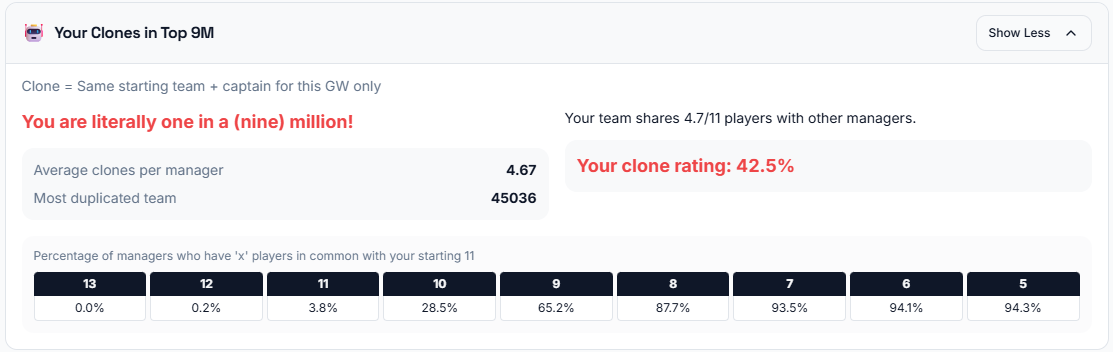
Eso explica perfectamente por qué mirar solamente una jornada no es suficiente. Compartir cinco jugadores puede ser simplemente template, e incluso compartir siete u ocho puede tener una explicación perfectamente legítima. Pero si durante varias jornadas dos equipos mantienen prácticamente la misma estructura y, además, realizan las mismas transferencias en la misma secuencia, la coincidencia empieza a contar una historia diferente.
¿Los clones realmente perjudican tu ranking?
Aquí aparece la primera gran molestia. FPL Harry no es cualquier manager. Entre sus mejores resultados históricos presume posiciones finales de 510, 1,345, 3,814, 5,401 y 6,470, es decir, múltiples temporadas terminando dentro del Top 10K. Imaginemos entonces que un creador con ese historial vuelve a tener una gran temporada y varios miles de managers están replicando sus movimientos. Si todos esos equipos permanecen cerca unos de otros, una parte considerable del ranking puede quedar ocupada por distintas cuentas que representan esencialmente la misma estrategia.
Desde esa perspectiva, para el manager que está tomando sus propias decisiones resulta fácil sentir que compite contra algo artificial. Pero hay un problema con ese argumento: también funciona al revés. Si existen miles de equipos iguales por encima de ti y tú consigues superar al equipo que todos ellos están replicando, potencialmente acabas de superar también a miles de clones. Lo que parecía una muralla puede convertirse en una catapulta. Por eso quizá no sea correcto decir que los clones necesariamente hacen más difícil subir en el ranking; en algunas jornadas pueden perjudicarte y en otras pueden provocar exactamente lo contrario.
Quizá los clones no hacen necesariamente más difícil el ranking. Lo que hacen es deformar su distribución.
Y eso cambia la discusión. Ya no estamos preguntando únicamente si alguien nos está quitando un lugar dentro del Top 10K; estamos preguntando si tiene sentido que una competencia que consideramos individual contenga bloques de miles de equipos tomando exactamente las mismas decisiones.
Cuando el problema entra a tu miniliga
En el overall rank todavía podemos discutir si los clones te benefician o perjudican, pero en una miniliga entre amigos la sensación puede ser muy diferente. Imagina una liga de 15 personas: amigos, familiares, compañeros de trabajo o simplemente un grupo que lleva años compitiendo. Catorce managers están revisando partidos, equivocándose con sus transferencias, acertando diferenciales y sufriendo cada fin de semana; el número quince decide hacer algo mucho más sencillo: copiar durante toda la temporada a un creador que termina dentro del Top 10K.
Si el creador tiene una gran temporada, probablemente nuestro amigo también. Y como consecuencia perfectamente puede terminar levantando la copa de la miniliga. Por lo que dentro del esquema de la competencia formalmente ganó. Los puntos están en su cuenta. Hizo las transferencias desde su teléfono y FPL no establece ninguna diferencia entre sus decisiones y las del resto.
Los puntos pueden ser tuyos. La pregunta es cuánto de las decisiones también lo fue.
¿Cómo criticas al ganador? Su respuesta probablemente será sencilla: esa fue su estrategia y funcionó. Y quizá tenga razón. Pero también es ahí donde hacer visible el fenómeno podría cambiar las cosas. Tal vez FPL ni siquiera necesite decidir inmediatamente quién merece o no merece un premio; quizá primero podría darnos información suficiente para que cada miniliga decida qué valor quiere darle a ese resultado.
¿Qué podemos hacer con los clones?
Esta semana lanzamos precisamente esa pregunta desde la cuenta de Bendito Fantasy. Las respuestas fueron desde el resignado “no se puede hacer nada” hasta distintas maneras de intentar modificar el juego, y la conversación no se limitó a nuestra publicación.
En Bluesky, Mark Church publicó una de las propuestas más creativas que encontramos: establecer una penalización relacionada con el número de equipos duplicados dentro del Top 1M. Su idea propone perder un punto por cada diez duplicados, con una deducción máxima de diez puntos.
Es una solución agresiva y tendría un problema inmediato: ¿cómo sabemos que alguien realmente está copiando? Castigar simplemente por tener un equipo idéntico durante una jornada podría penalizar coincidencias perfectamente legítimas, especialmente cuando existe un template muy marcado. Por eso hay otra alternativa que me parece particularmente interesante.
En lugar de castigar al clon, premiemos al scout
El Fantasy del Mundial 2026 utilizó una regla que sería fascinante probar dentro de FPL: el Scouting Bonus.
El mecanismo premiaba con dos puntos adicionales a un jugador con menos de 5% de selección cuando conseguía más de cuatro puntos en un partido.
La idea encaja sorprendentemente bien con este problema porque cambia completamente el incentivo. Y en lugar de perseguir a quien copia, premias a quien encuentra algo diferente. De esa manera, si detectas antes que los demás a un jugador de baja selección y funciona, recibes una recompensa. Si un creador recomienda al futbolista y miles de managers comienzan a incorporarlo, eventualmente deja de estar debajo del porcentaje necesario y desaparece esa ventaja.
Tu descubrimiento deja de valer puntos adicionales precisamente cuando deja de ser un descubrimiento.
Esta elegante solución no elimina los clones, pero introduce un elemento que recompensa el scouting, el riesgo y la capacidad de separarse del template. Y quizá eso sea más interesante que simplemente repartir castigos.
¿Y si FPL simplemente los identifica?
Hay una tercera posibilidad: no quitar puntos, no prohibir equipos y no impedir que alguien copie. Simplemente hacerlo visible.
FPL tiene los datos necesarios para observar cómo cambia un equipo jornada tras jornada. Podría desarrollar una métrica que no busque coincidencias durante una semana, sino patrones durante cuatro, cinco, seis o más jornadas. Mismo equipo, misma transferencia; siguiente jornada, misma estructura, mismo movimiento; después otra vez. Una coincidencia puede ser casualidad, pero cinco jornadas reproduciendo la misma secuencia de decisiones empiezan a parecer algo distinto.
Si el patrón alcanza determinado nivel, FPL podría mostrarlo en el perfil del manager y en las miniligas con una advertencia como “Alta coincidencia sostenida de decisiones” o incluso “Patrón de clonación detectado”. Si se mantiene durante un tercio de la temporada, entonces podríamos empezar otra discusión: ¿debería ese equipo seguir siendo elegible para determinadas copas, premios o reconocimientos? No estoy convencido de que quitarle puntos sea la solución, pero sí me gustaría saberlo cuando estoy compitiendo contra él.
¿Pero quién copió a quién?
Y aquí mi propia propuesta empieza a complicarse. Supongamos que encontramos diez equipos realizando exactamente las mismas transferencias durante cinco jornadas. ¿Quién es el original? La respuesta no necesariamente es el creador de contenido con más seguidores.
El FPL moderno está lleno de modelos de puntos esperados, optimizadores, herramientas estadísticas y sistemas que recomiendan transferencias. Muchos creadores pagan por estos servicios y utilizan esas proyecciones como parte de su proceso de decisión.
Entonces puede ocurrir algo perfectamente razonable: el creador A consulta un modelo y llega a determinado equipo; el manager B tiene acceso a la misma herramienta, hace el mismo ejercicio y obtiene prácticamente la misma recomendación. B nunca vio el video de A. ¿Lo copió? Probablemente no. Y todavía podemos ir un paso más lejos: quizá el creador que miles de personas consideran el “original” tampoco construyó independientemente ese equipo, sino que simplemente siguió las recomendaciones del mismo modelo.
Entonces la pregunta “¿quién copió a quién?” empieza a perder utilidad. Quizá lo que realmente podemos detectar no sea la autoría, sino el patrón.
No importa necesariamente si el manager está siguiendo a FPL Harry, a otro creador, a un algoritmo o a un optimizador. Lo que podemos medir es hasta qué punto determinadas decisiones se están reproduciendo sistemáticamente. Ni siquiera eso sería infalible, pero nos permitiría empezar a distinguir entre dos cosas que hoy metemos dentro del mismo ranking sin ninguna diferencia visible: miles de managers llegando a decisiones parecidas y miles de equipos reproduciendo sistemáticamente una misma secuencia de decisiones.
¿Tenemos realmente un problema?
Tal vez esa sea la pregunta que todavía no hemos contestado. LiveFPL ya demuestra que podemos medir similitud entre equipos: la herramienta cuenta clones para una jornada, calcula un clone rating y mide cuántos jugadores compartes con otros managers. Pero quizá la métrica realmente interesante todavía no existe. La pregunta no sería “¿Cuántos equipos son iguales al mío hoy?”, sino “¿Cuántos llevan semanas tomando las mismas decisiones?”
FPL siempre ha sido un juego de información. Todos vemos los mismos partidos. Todos tenemos acceso a estadísticas. Todos podemos escuchar podcasts, leer artículos, revisar modelos y seguir creadores.
Sería absurdo pedir que cada decisión apareciera espontáneamente dentro de nuestra cabeza, pero existe una diferencia entre utilizar información para tomar una decisión y pedir que alguien más tome todas las decisiones por ti. Dónde está exactamente esa frontera es mucho más difícil de determinar, y quizá por eso La guerra de los clones apenas está comenzando.
Queremos saber qué harían ustedes. ¿Penalizarían a los equipos duplicados? ¿Incorporarían un Scouting Bonus? ¿Mostrarían públicamente un índice de clonación? ¿Excluirían de copas a quienes mantengan patrones extremos durante buena parte de la temporada? ¿O simplemente dejarían todo exactamente como está? La conversación queda abierta.
Espantapájaros
Estamos a punto de entrar a una nueva fecha FIFA que, a mi parecer, llega demasiado pronto después de haber tenido un Mundial. Y no solamente llega pronto: tendremos una ventana internacional particularmente larga.
Hay algo que tradicionalmente acompaña estos parones y que en el argot futbolero conocemos como el virus FIFA. Los jugadores abandonan sus clubes, se incorporan a sus selecciones y algunos regresan lesionados. Pero también existe el fenómeno contrario: esas oportunas molestias físicas que aparecen justo antes de que un futbolista tenga que viajar con su selección. Algunas son completamente reales; otras inevitablemente generan sospechas sobre cuánto interés tiene un club en permitir que uno de sus jugadores más importantes acumule minutos adicionales lejos de casa.
Esta semana tenemos un caso particularmente interesante con João Pedro.
El delantero fue retirado de la convocatoria de Brasil por lesión y sustituido por Martinelli, de Fluminense. Al mismo tiempo, Xabi Alonso no lo ha descartado definitivamente para el partido de Chelsea contra Brentford y ha dejado la decisión pendiente de la última sesión de entrenamiento.
Conveniente o no, para nosotros lo importante es qué hacer con esa información en Fantasy, y mi postura por ahora es tener paciencia. João Pedro está atravesando un gran momento y una lesión que coincide con una fecha FIFA no me parece razón suficiente para salir corriendo a venderlo antes de conocer mejor su situación. Para eso también construimos una buena banca.
Esperemos información. Y si resulta que después de descansar durante la fecha FIFA está listo para volver con Chelsea, quizá descubramos que esta vez el famoso virus FIFA llegó antes de que comenzara la fecha FIFA.
6,000 clones. Not six. Not sixty. Not six hundred. People are talking about six thousand.
This week, a conversation that has been hovering around Fantasy Premier League for a while flared up again. A particularly striking claim began circulating on social media: FPL Harry may have around 6,000 clones of his team. Whether the exact number is six thousand is not really the point; what matters is the scale that this phenomenon appears to have reached.
There are plenty of content creators who analyse players, fixtures, statistics, transfers and captaincy options every week. We do exactly that ourselves. But many English creators also have the habit of revealing their own teams before the deadline, often during a live stream. And there are people who do not just listen to the advice: they copy the entire team, with the same players, the same transfers and the same captain, then do it all over again the following gameweek.
At first, that may seem irrelevant. After all, every manager should be able to play the game however they want. The problem begins when we stop talking about ten or twenty people and start talking about thousands.
What happens to an individual competition when thousands of participants are effectively playing with one mind?
Matching is not the same as copying
Before reaching for the torches, one thing needs to be made clear: having the same players does not automatically make anyone a clone.
Some players simply become part of the template. If Haaland is in excellent form and has strong fixtures ahead, it is perfectly reasonable for thousands of managers to independently conclude that they should own him. The same can be true for Morgan Rogers, João Pedro or any player who, at a given moment, combines price, minutes, form and fixtures.
In fact, LiveFPL has a particularly interesting tool for looking at this phenomenon. Its current definition of a clone is quite specific: the same starting XI and the same captain in that gameweek. The site also calculates a clone rating and shows what percentage of managers share a given number of players with your starting XI.
When I checked my own team this week, the result said I was literally one in nine million. My clone rating was around 42.5. But the really interesting part was further down: around 94% of teams shared at least five players with mine, while once the overlap reached 12 players, that figure dropped to roughly 0.2%.
That is a perfect illustration of why looking at a single gameweek is not enough. Sharing five players can simply be the template, and even sharing seven or eight can have a perfectly legitimate explanation. But if two teams keep almost the same structure across several gameweeks and, on top of that, make the same transfers in the same sequence, the coincidence starts to tell a different story.
Do clones really hurt your rank?
This is where the first major frustration appears. FPL Harry is not just any manager. Among his best historical finishes are ranks of 510, 1,345, 3,814, 5,401 and 6,470, meaning he has finished inside the Top 10K several times. Now imagine that a creator with that kind of record has another strong season and several thousand managers are replicating his moves. If all those teams remain close together, a significant part of the overall ranking could be occupied by different accounts that are essentially representing the same strategy.
From that perspective, it is easy for a manager making independent decisions to feel as though they are competing against something artificial. But there is a problem with that argument: it works the other way too. If thousands of identical teams are above you and you manage to beat the team they are all replicating, you may also leapfrog thousands of clones at once. What looked like a wall can turn into a catapult. So it may not be accurate to say that clones necessarily make it harder to climb the rankings; in some gameweeks they can work against you, and in others they can create exactly the opposite effect.
Maybe clones do not necessarily make the rankings harder. Maybe they distort how the rankings are distributed.
And that changes the discussion. We are no longer asking only whether someone is taking a place away from us inside the Top 10K; we are asking whether it makes sense for a competition we consider individual to contain blocks of thousands of teams making exactly the same decisions.
When the problem enters your mini-league
In the overall ranking, we can still debate whether clones help or hurt you, but in a mini-league with friends the feeling can be very different. Imagine a league of 15 people: friends, family members, co-workers or simply a group that has been competing for years. Fourteen managers are watching matches, getting transfers wrong, finding successful differentials and suffering every weekend; the fifteenth decides to do something much simpler and copy a content creator who eventually finishes inside the Top 10K.
If the creator has a great season, our friend probably will too. And as a result, they may end up lifting the mini-league trophy. Within the formal structure of the game, they won. The points are on their account. They made the transfers from their own phone and FPL makes no distinction between their decisions and everyone else's.
The points may be yours. The question is how much of the decision-making was yours too.
How do you criticise the winner? Their answer will probably be simple: that was their strategy, and it worked. And maybe they are right. But this is also where making the phenomenon visible could change things. FPL may not even need to decide immediately who does or does not deserve a prize; perhaps it could simply give mini-leagues enough information to decide for themselves what they think that result is worth.
What can we do about clones?
This week, we asked exactly that question from the Bendito Fantasy account. The responses ranged from the resigned “nothing can be done” to different ideas for changing the game, and the conversation was not limited to our post.
On Bluesky, Mark Church published one of the more creative proposals we found: apply a penalty based on the number of duplicated teams inside the Top 1M. His idea would deduct one point for every ten duplicates, with a maximum deduction of ten points.
It is an aggressive solution, and it immediately raises a problem: how do we know someone is actually copying? Punishing someone simply for having an identical team in one gameweek could hit perfectly legitimate coincidences, especially when the template is particularly strong. That is why there is another alternative that I find especially interesting.
Instead of punishing the clone, reward the scout
The 2026 World Cup Fantasy game used a rule that would be fascinating to test in FPL: the Scouting Bonus.
The mechanism awarded two additional points to a player owned by less than 5% of managers if that player scored more than four points in a match.
The idea fits this problem surprisingly well because it changes the incentive completely. Instead of chasing people who copy, you reward people who find something different. If you identify a low-owned player before everyone else and it works, you get an extra reward. If a creator recommends that player and thousands of managers start buying him, eventually the ownership rises above the threshold and that advantage disappears.
Your discovery stops earning extra points precisely when it stops being a discovery.
This elegant solution does not eliminate clones, but it introduces an element that rewards scouting, risk and the ability to move away from the template. And perhaps that is more interesting than simply handing out punishments.
What if FPL simply identified them?
There is a third possibility: do not deduct points, do not ban teams and do not stop anyone from copying. Simply make it visible.
FPL has the data required to see how a team changes from one gameweek to the next. It could develop a metric that does not look for a one-week coincidence, but for patterns across four, five, six or more gameweeks. Same team, same transfer; next gameweek, same structure, same move; then again. One coincidence can be random, but five gameweeks reproducing the same sequence of decisions starts to look like something else.
If the pattern reaches a certain level, FPL could display it on the manager profile and inside mini-leagues with a warning such as “Sustained high decision similarity” or even “Cloning pattern detected.” If that continued for more than a third of the season, then we could open another discussion: should that team still be eligible for certain cups, prizes or competitive recognitions? I am not convinced that deducting points is the answer, but I would like to know when I am competing against one.
But who copied whom?
And this is where my own proposal starts to get complicated. Suppose we find ten teams making exactly the same transfers over five gameweeks. Who is the original? The answer is not necessarily the content creator with the biggest following.
Modern FPL is full of expected-points models, optimisers, statistical tools and systems that recommend transfers. Many creators pay for these services and use those projections as part of their own decision-making process.
So something perfectly reasonable can happen: Creator A checks a model and arrives at a certain team; Manager B has access to the same tool, runs the same exercise and receives almost the same recommendation. B never watched A's video. Did B copy them? Probably not. And we can go one step further: perhaps the creator that thousands of people consider the “original” did not independently build that team either, but simply followed the same model.
At that point, the question “who copied whom?” starts to become less useful. Maybe what we can actually detect is not authorship, but the pattern.
It does not necessarily matter whether a manager is following FPL Harry, another creator, an algorithm or an optimiser. What we can measure is the extent to which certain decisions are being systematically replicated. Even that would not be infallible, but it would at least allow us to start distinguishing between two things that currently sit in the same ranking with no visible difference: thousands of managers independently arriving at similar decisions, and thousands of teams systematically reproducing the same sequence of decisions.
Do we actually have a problem?
Maybe that is the question we still have not answered. LiveFPL already shows that team similarity can be measured: the tool counts clones for a single gameweek, calculates a clone rating and measures how many players you share with other managers. But perhaps the most interesting metric still does not exist. The question would not be “How many teams are identical to mine today?” but “How many have been making the same decisions for weeks?”
FPL has always been a game of information. We all watch the same matches. We all have access to statistics. We can all listen to podcasts, read articles, check models and follow creators.
It would be absurd to demand that every decision somehow appear spontaneously inside our own heads, but there is a difference between using information to make a decision and asking someone else to make every decision for you. Where exactly that line sits is much harder to define, and perhaps that is why The Clone Wars are only just beginning.
We want to know what you would do. Would you penalise duplicated teams? Add a Scouting Bonus? Publicly display a cloning index? Exclude managers with extreme patterns from cups if those patterns last for a significant part of the season? Or would you leave everything exactly as it is? The conversation remains open.
Final Whistle
We are about to enter another international break, one that in my opinion arrives far too soon after a World Cup. And not only does it arrive quickly: this will be a particularly long international window.
There is something that traditionally comes with these breaks and that football fans often call the FIFA virus. Players leave their clubs, join their national teams and some of them come back injured. But there is another phenomenon too: those conveniently timed physical problems that appear just before a player is due to travel with their national team. Some are completely genuine; others inevitably raise suspicions about how interested a club really is in allowing one of its most important players to accumulate extra minutes away from home.
This week, we have a particularly interesting case with João Pedro.
The striker was withdrawn from Brazil's squad because of injury and replaced by Martinelli, of Fluminense. At the same time, Xabi Alonso has not completely ruled him out of Chelsea's match against Brentford and has left the final decision until after the last training session.
Convenient or not, for us the important question is what to do with that information in Fantasy, and for now my position is to be patient. João Pedro is in excellent form, and an injury that happens to coincide with an international break is not enough reason for me to rush into selling him before we know more. That is also why we build a good bench.
Wait for information. And if it turns out that, after resting through the international break, he is ready to return for Chelsea, perhaps we will discover that this time the famous FIFA virus arrived before the international break even began.